

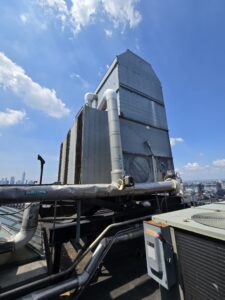
Cooling towers sit under more regulation than almost any other piece of equipment a New York building owner operates, and the requirements governing them changed again this spring. Registration, a written maintenance program, routine inspection, laboratory testing and annual certification all apply, and they attach to each tower rather than to the building. The 2026 season has been the first one running under a monthly testing requirement, and this fall brings the first shutdown and certification to follow it.
A cooling tower works by evaporating water, which releases a fine mist into the air around and above the building. Where Legionella bacteria have established in a system that is not well controlled, inhaling that mist can cause Legionnaires’ disease, a severe pneumonia that is treatable but can be fatal. Those bacteria multiply quickly in warm water that sits still, which is why the intervals are written as tightly as they are.
What Changed in May, and What Stayed the Same
|
Effective May 7, 2026, under Local Law 159 of 2025 ● Legionella culture sampling at least every 31 days while a system is operating, replacing the quarterly interval ● Startup and shutdown events reported electronically to the Health Department within five days ● All culture analysis performed by a laboratory accredited under the state ELAP program ● No-flow conditions of three days or more now trigger defined risk management procedures ● Doubled penalties for registration, certification and inspection violations |
A good deal stayed where it was. Compliance inspections by a qualified person remain on a 90 day cycle, weekly monitoring continues as before, and summertime hyperhalogenation between July 1 and August 31 is still required for any system operating in that window. Certification remains due by November 1, and each tower still needs its own entry in the city and state registries.
The Document Everything Else Hangs On
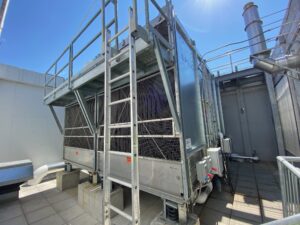
The maintenance program and plan is the spine of a compliance file, and inspectors read it first. It has to be developed by a qualified person, follow the manufacturer instructions for the specific equipment on site, and align with sections 5, 6 and 7.2 of ASHRAE Standard 188. The most common weakness we see is a plan that describes procedures nobody actually performs. Where a building already runs a preventive service and maintenance program, the plan is worth reconciling against it each season.
Startup and the Fifteen Day Window
Before a system that has been idle or untreated for five or more days returns to service, it has to be cleaned and disinfected no later than fifteen days before first use. The city startup procedures set out the sequence, which means removing biofilm and scale before an approved biocide is dosed to a verified residual. A pre-startup inspection follows, and the collection date for the post-startup samples goes into the city portal within five days. The underlying rule text also treats any tower coming back from replacement and upgrade work as a fresh startup.
When a Result Comes Back Elevated
An elevated reading is better handled as an active condition than as a filing obligation.
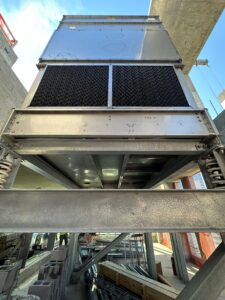
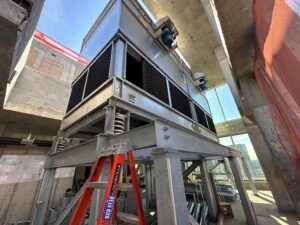
Culture takes several days to grow, so every result describes the tower as it stood on the collection date rather than on the day the number arrives. Table 8-1 in Chapter 8 sets the response for each result band, and the state rules add a layer of their own. A culture at or above 1,000 colony forming units per milliliter requires notification to the local health department within 24 hours, and lower results still trigger a treatment review and a retest. Our applicators are certified to apply biocide in cooling towers under the state requirements, so remediation can begin on the same emergency service call.
Shutdown and the November Certification
Seasonal shutdown involves a great deal more than switching off a pump, since the system has to be cleaned and disinfected per the plan and left in a condition that will not create a reservoir over the winter. The Health Department publishes operation and shutdown guidance covering the common configurations, and the shutdown itself has to be reported within five days. Certification by November 1 attests that each tower had a compliant plan and that the requirements were met all season, which is why it is worth signing against a reconciled file rather than from memory.
A Compliance Calendar for a Seasonal System
| When | What Has to Happen |
| Before first seasonal use | Clean and disinfect no later than 15 days prior. Pre-startup inspection by a qualified person. Verify the plan reflects current equipment and vendors. |
| At startup | Report the startup electronically within five days. Collect Legionella samples inside the defined post-startup window and submit the collection date within five days. |
| Daily, in operation | Record pH, temperature, conductivity and biocide residual. |
| Weekly, in operation | Visual inspection and recorded water quality parameters, including drift eliminators and basin condition. |
| Every 31 days | Legionella culture sampling, analyzed by an accredited laboratory, with results and dates reported inside the required windows. |
| July 1 to August 31 | Summertime hyperhalogenation for any system operating in that period. |
| Every 90 days | Compliance inspection by a qualified person who is not performing the routine maintenance. Update the state registry. |
| After 5 idle days | Full startup procedure applies again, including cleaning, disinfection and sampling. Three or more days without flow triggers defined risk procedures. |
| At shutdown | Clean, disinfect and lay up per the plan. Report the shutdown within five days. |
| By November 1 | Annual certification that the plan existed, was followed and that requirements were met. Retain records for at least three years. |
The rest of a building’s equipment runs on a schedule of its own, covered separately in how often commercial HVAC systems should be maintained, and tower performance sits inside the wider question of commercial HVAC energy efficiency.
Where Owners Usually Get Caught
|
The findings that show up at inspection are almost always administrative ● A collection date logged late in the portal ● A startup or shutdown that happens but is never reported ● An inspection performed by the technician who handles the weekly rounds ● A plan that still names a chemical program the building stopped using two seasons ago ● A three day no-flow period during a pump repair that nobody flagged as a triggering event |
Every one of those costs very little to prevent and takes a considerable amount of explaining afterward, particularly now that the Health Department inspects registered buildings on a rolling basis rather than on request.
Henick-Lane holds the full cycle for building owners across the five boroughs, so the record supporting a certification is built as the season runs instead of being reconstructed in October. That work runs across office, institutional and medical facilities and laboratories, and the project list shows where.
Reviewing a Tower File Before the Deadline
A gap discovered in October is far easier to address than one discovered during an inspection. If a tower changed hands, changed vendors or changed chemical programs this year, get in touch with our team online, call (718) 786-7277 or email info@henick-lane.com to arrange a review before the certification date arrives.